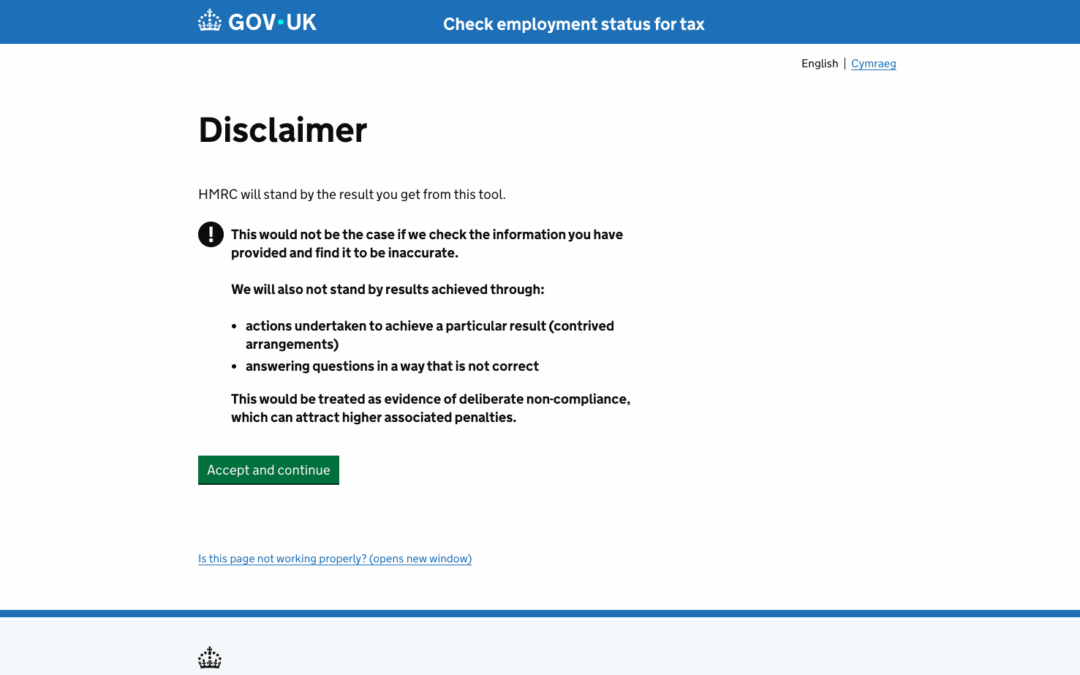
The Issues With CEST
The UK government’s Check Employment Status for Tax (CEST) tool was introduced by HMRC to help organisations determine whether contractors fall inside or outside the scope of the IR35 off-payroll working rules. The tool is widely used by end-clients, recruitment agencies and contractors to assist with issuing Status Determination Statements (SDS).
While CEST offers a free and accessible way to assess employment status, it has been widely criticised by tax specialists and industry professionals for its limitations. In practice, the tool often struggles to reflect the complexities of real-world contractor engagements and should not be relied upon as a definitive assessment method.
Below are some of the key reasons why CEST is widely regarded as an imperfect tool for determining IR35 status.
A Simplistic Format
One of the main weaknesses of CEST lies in its reliance on a simple format to ask questions and garner asnwers. Users answer a series of multiple choice questions about working practices and contractual arrangements, and the tool then produces a determination based on those responses. Nothing is saved, its a single use approach, and very little else is considered.
However, employment status under UK tax law is rarely straightforward. Tribunal decisions consistently show that determining whether a contractor is genuinely self-employed requires a holistic review of the entire working relationship. The nuanced nature of many engagements means that simple answers cannot always capture the full picture.
Because of this rigid format, CEST can struggle to account for the subtleties of a contractor’s working arrangement. A contractor may have a complex blend of autonomy, project-based deliverables and commercial risk that cannot easily be expressed through a fixed set of questions. As a result, the tool may produce outcomes that do not accurately reflect the reality of the engagement.
Inconsistent Interpretation of Questions
Another issue with the tool is that it can be completed, separately, by different parties in the supply chain, the contractor, the recruitment agency, or the end client. Each of these stakeholders may interpret the questions differently, particularly where the wording is ambiguous. This means there is a failure to get a joined up, agreed, and documented opinion between those parties.
For example, questions relating to supervision, control or substitution can be interpreted in different ways depending on a person’s understanding of employment law. Two individuals completing the same questionnaire for the same role may therefore arrive at different answers and potentially different determinations.
This subjectivity undermines the reliability of the tool and highlights the importance of professional judgement when assessing IR35 status. Private solutions such as The Contractor Compliance Portal now offer a far better solution, is free to use, and can be top and tailed with IR35 insurance to provide complete protection and peace of mind.
Unable to Determine Outcomes
Perhaps one of the most telling limitations of CEST is that it does not always provide a clear answer. In fact, HMRC’s own usage data has shown that the tool fails to produce a determination in roughly one in five cases, returning an ‘unable to determine’ outcome instead.
When this happens, users are left without the clarity they were seeking. Organisations must then rely on alternative assessment methods or obtain specialist advice to determine the contractor’s status.
For businesses trying to ensure compliance with the off-payroll rules, this lack of certainty can create additional administrative burden and risk.
The Mutuality of Obligation Problem
One of the most widely criticised aspects of CEST is its treatment of Mutuality of Obligation (MOO). Alongside control and personal service, MOO is considered one of the key legal tests used by courts when determining employment status.
MOO examines whether the engager is obliged to offer work and whether the worker is obliged to accept it. A strong mutual obligation often indicates an employment relationship, whereas project-based engagements with no ongoing obligation typically support self-employment.
Historically, CEST has largely ignored this factor, assuming that mutuality exists whenever a contract is in place. This assumption conflicts with many employment status cases, where tribunals have closely examined the level of obligation between the parties.
By failing to fully assess this key element, the tool risks overlooking an important part of the legal framework underpinning IR35.
Not Fully Aligned with Case Law
Another criticism frequently levelled at CEST is that it does not always reflect the latest developments in employment status case law. Tribunal rulings regularly refine how the courts interpret concepts such as control, substitution and financial risk.
If a status assessment tool does not incorporate these evolving legal principles, it may generate outcomes that differ from how a tribunal would ultimately judge the same engagement. This disconnect creates uncertainty for organisations relying on the tool as their primary compliance method.
A Tool, Not a Complete Solution
Despite its shortcomings, CEST can still play a role in IR35 compliance. It provides a basic framework for considering some of the key employment status factors and may be useful as an initial assessment.
However, it should not be treated as a definitive answer. The complexity of employment status law means that robust IR35 assessments often require a more detailed review of both contractual terms and real-world working practices.
For many organisations, this means combining tools like CEST with independent assessments, professional advice or dedicated IR35 compliance systems.
Final Thoughts
HMRC’s CEST tool was created to simplify the process of determining employment status under IR35, but the reality is that contractor engagements are rarely simple. The tool’s rigid format, inconsistent interpretation, inability to determine status in many cases and limited treatment of key legal tests all highlight its limitations.
Ultimately, while CEST can be a helpful starting point, businesses and contractors should recognise that it is only one piece of the compliance puzzle, and relying on it alone may not provide the certainty required when dealing with the complexities of IR35.