Autumn Budget 2026: Business Asset Disposal Relief Cut Could Cost Contractors Thousands
Limited company contractors considering selling or closing their businesses have been given an important new tax deadline following the Autumn Budget on the 28th of October 2026.
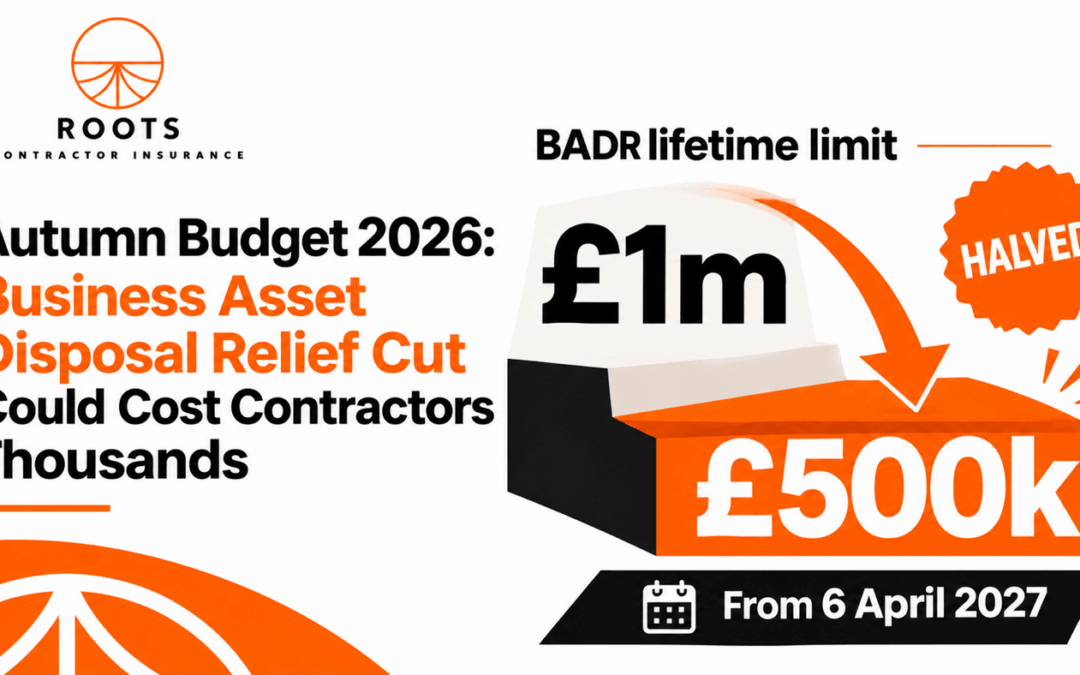
The government has announced that Business Asset Disposal Relief (BADR) will be reduced to £500,000 of qualifying lifetime gains from the 6th of April 2027, down from the current £1 million limit.
BADR, previously known as Entrepreneurs’ Relief, allows eligible business owners to pay a reduced rate of Capital Gains Tax when disposing of qualifying business assets or shares.
Although the tax rate remains at 18%, reducing the lifetime allowance means that contractors and business owners with larger gains could face significantly higher tax bills.
The change is expected to affect approximately 13,000 individuals, although the government estimates that three-quarters of existing BADR claimants will remain unaffected.
What exactly is changing?
Until the 5th of April 2027, an eligible individual can claim BADR on up to £1 million of qualifying gains across their lifetime, taking account of previous claims. From the 6th April 2027, the limit will fall to £500,000.
Qualifying gains within the available limit are charged at 18%. Gains above the limit are subject to normal Capital Gains Tax rules, potentially 24% for a higher-rate taxpayer.
The new £500,000 limit is per individual, not per company or transaction. Someone who has previously used £300,000 of their BADR allowance would therefore have only £200,000 remaining once the new cap applies.
The reduction applies to qualifying disposals made on or after the 6th of April 2027; it is not a retrospective tax charge on disposals already completed.
How much could the change cost?
Consider a contractor who has built a valuable consultancy and makes a £750,000 qualifying gain on selling their shares.
Assume they have not previously used BADR and are otherwise liable to Capital Gains Tax at 24% on gains outside the relief.
Under the current £1 million limit, the entire £750,000 gain could qualify at 18%, producing a tax liability of £135,000.
Under the new £500,000 limit, £500,000 could qualify at 18% (£90,000), while the remaining £250,000 could be taxed at 24% (£60,000).
That produces a total liability of £150,000, an additional £15,000.
This simplified illustration excludes the annual Capital Gains Tax exemption, losses and other individual circumstances. Actual liabilities will vary.
Do limited company contractors qualify automatically?
No. Simply operating a personal service company does not guarantee eligibility for BADR.
For a typical disposal of company shares, HMRC’s conditions generally require the company to have been a trading company, or the holding company of a trading group, throughout the relevant two-year qualifying period.
The individual must also have been an officer or employee and generally held at least 5% of the company’s ordinary share capital and voting rights, alongside a qualifying economic entitlement to profits, assets or sale proceeds.
These requirements are particularly important where contractors have multiple shareholders, different share classes or substantial non-trading activities.
Selling shares and extracting funds through a company liquidation can also produce different tax consequences. Professional advice should be obtained before assuming that a particular disposal qualifies.
Should contractors bring forward a sale or closure?
A qualifying disposal completed before the 6th of April 2027 may fall under the existing £1 million lifetime limit.
However, rushing a transaction purely for tax reasons can be costly.
HMRC has published proposed anti-forestalling rules covering certain contracts signed before the change but completed afterwards, alongside specified share reorganisations.
Simply signing an agreement before April will not necessarily preserve the existing limit.
Contractors contemplating a genuine sale, retirement or company closure should ask a qualified tax adviser to assess eligibility, transaction structure, timing and previous BADR claims before taking action.
Does this affect IR35?
The BADR announcement does not change IR35 or the off-payroll working rules.
Those rules determine the tax treatment of particular engagements, while BADR concerns the taxation of qualifying business disposals.
Nevertheless, good contracting practice remains important.
Written agreements should reflect actual working arrangements, and an IR35 Status Review can help identify potential status issues before an engagement begins.
IR35 Insurance may provide specified protection in covered HMRC enquiries, subject to policy terms.
Separately, Professional Indemnity Insurance, Public Liability Insurance and Employers’ Liability Insurance address different business risks. None of these policies should be treated as protection against changes in Capital Gains Tax legislation.
The key takeaway
The Autumn Budget has halved the amount of lifetime gains eligible for BADR from April 2027, rather than abolishing the relief.
Many smaller disposals will remain unaffected, but contractors with valuable businesses or significant previous BADR claims should review their position.
Understanding whether the relief applies, and when a disposal actually occurs, could make a material difference to the final tax bill.
Frequently Asked Questions
Is Business Asset Disposal Relief being abolished?
No. The 18% relief remains, but the lifetime limit is being reduced to £500,000 for qualifying disposals from the 6th of April 2027.
Does the £500,000 limit apply to each company?
No. BADR is a cumulative lifetime limit for each eligible individual, including relevant previous claims.
Will every limited company contractor qualify?
No. Trading-company, shareholding, economic-interest and qualifying-period conditions must be met.
Does the Budget change IR35?
This BADR measure does not change IR35. The two tax regimes address different issues.