Home Office Faces £80.7m IR35 Exposure: Why Outsourced Contracts Could Be the Next Major Compliance Risk
The Home Office has become the latest government department to disclose substantial potential liabilities associated with the off-payroll working rules, commonly known as IR35.
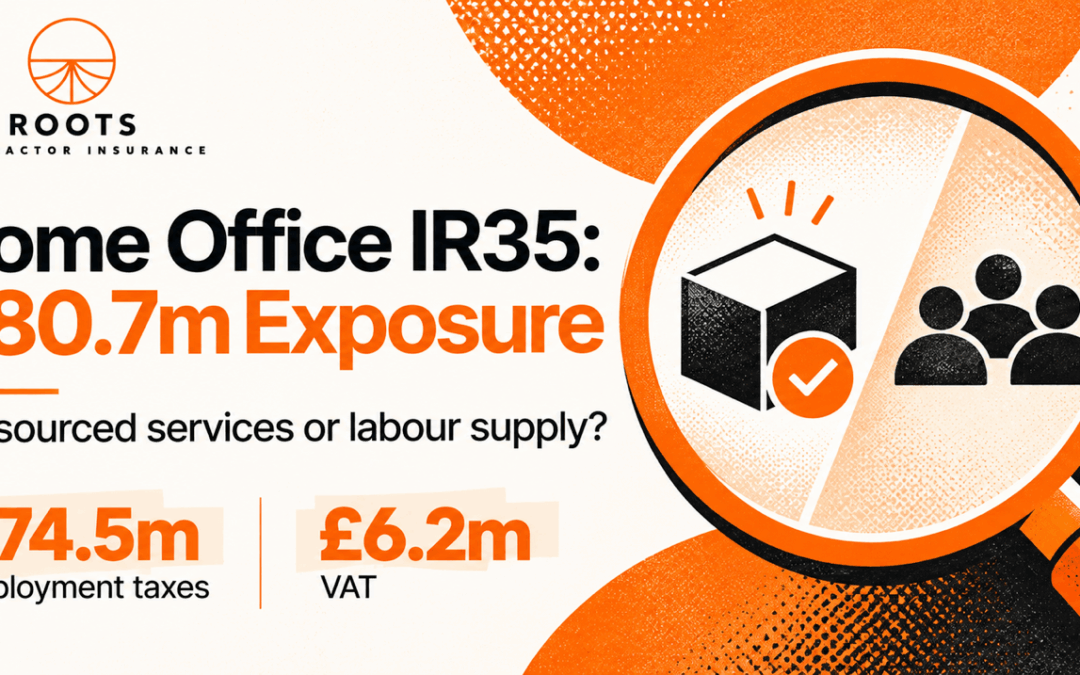
Analysis reported on the 6th of November 2026 of the department’s 2025–26 annual accounts identified £80.7 million in provisions and accruals linked to historic contractor arrangements.
The disclosure includes £74.5 million for potential employment taxes and interest, alongside £6.2 million relating to VAT.
The issue is particularly significant because it concerns supplier contracts originally classified as outsourced services but subsequently identified as arrangements involving the supply of workers.
For contractors, recruitment agencies, consultancies and end clients, the case raises an important question: when does a genuine outsourced service become a labour-supply arrangement requiring IR35 consideration?
What happened at the Home Office?
According to the department’s financial disclosures, possible historic failures to comply with the off-payroll working rules were identified during 2025–26.
The arrangements had initially been treated as contracted-out services. However, subsequent examination indicated that some involved the supply of workers.
That distinction can fundamentally change which organisation is responsible for assessing employment status and accounting for relevant employment taxes.
The £74.5 million provision is an estimate rather than a final settlement with HMRC. The accounts do not identify the suppliers involved or disclose how many contractors may have been affected.
Consequently, it would be incorrect to assume that every affected engagement was necessarily inside IR35 or that HMRC has imposed a penalty of £80.7 million.
Outsourced services versus labour supply: why the distinction matters
A genuinely outsourced service generally involves a business purchasing a defined service or outcome from another organisation.
For example, a consultancy might agree to design and deliver an IT system, taking responsibility for managing its personnel, delivery methods and contractual obligations.
By contrast, a labour-supply arrangement may involve individual contractors being provided to work within the client’s organisation, potentially under its day-to-day direction.
The commercial reality matters more than the description on the contract.
Calling an agreement a Statement of Work or managed service does not automatically establish that the engagement is genuinely outsourced.
Where the arrangement is effectively the supply of workers through intermediaries, the off-payroll rules may apply to the relevant engagements.
Why Statements of Work deserve closer scrutiny
Statements of Work (SoW) are commonly used by consultancies and organisations engaging specialist contractors.
They can be entirely appropriate where a supplier is genuinely responsible for delivering agreed outcomes.
However, difficulties can arise where a Statement of Work describes a project deliverable but the practical arrangement resembles conventional contractor placement.
Warning signs may include individual workers being selected and managed directly by the client, payment arrangements based predominantly on individual time rather than deliverables, or limited responsibility resting with the supplier for managing the service.
None of these factors is automatically decisive. The full contractual and working relationship must be considered.
For recruitment agencies and consultancies, understanding the difference is particularly important when establishing supply-chain responsibilities.
What does this mean for recruitment agencies and end clients?
Under the off-payroll working rules, public authorities and medium or large private-sector clients generally have responsibilities for determining employment status where the legislation applies.
Those responsibilities cannot necessarily be avoided simply by inserting a consultancy or other supplier into the contractual chain.
Organisations should therefore examine how services are actually delivered, who controls the work, who manages the individuals involved and which party is genuinely responsible for delivering the agreed outcome.
The Home Office disclosure illustrates how significant liabilities can accumulate when the original classification of an arrangement is incorrect.
It also highlights the need to review existing arrangements rather than assuming that a contract remains correctly classified throughout its duration.
What should individual contractors do?
For limited company contractors, the development reinforces the importance of understanding the structure of each engagement.
A contractor working through a consultancy should not automatically assume that IR35 is irrelevant simply because the agreement is described as outsourced.
Equally, working on a client project does not automatically mean an engagement falls inside IR35.
Contractors should understand who their contractual client is, which organisation is responsible for the relevant status determination and whether the written agreement accurately reflects their working practices.
An IR35 Status Review can help identify contractual provisions requiring clarification before an engagement begins or is renewed.
Where a client is required to issue a Status Determination Statement, contractors should understand the determination and the reasons supporting it.
Can IR35 Insurance help manage the risk?
Even carefully structured engagements may face scrutiny from HMRC.
IR35 Insurance can provide specified protection in connection with covered HMRC investigations and, depending on the policy, certain resulting liabilities.
However, insurance is not a substitute for correct contractual classification, appropriate status assessments or accurate working practices. The insured party, exclusions and policy limits are particularly important.
Contractors should also consider their wider commercial exposures. Professional Indemnity Insurance can address covered professional-negligence claims, while Public Liability Insurance and Employers’ Liability Insurance address different risks where appropriate.
Getting the classification right comes first
The Home Office’s £80.7 million exposure is another reminder of the financial consequences associated with IR35 compliance failures.
However, its most important lesson differs from the familiar debate about whether individual contractors are inside or outside IR35.
Before determining employment status, organisations must first establish what they are actually buying: a genuinely outsourced service or the supply of workers.
For recruitment agencies, consultancies, end clients and contractors, understanding that distinction is essential to establishing the correct compliance responsibilities.
Frequently Asked Questions
Has HMRC fined the Home Office £80.7 million?
No. The figure comprises estimated employment-tax liabilities and a separate VAT accrual. It is not a confirmed fine or final settlement.
Are outsourced consultancy services automatically outside IR35?
No. Genuine outsourced services can be treated differently from labour-supply arrangements, but the actual contractual and working arrangements determine which rules apply.
Does using a Statement of Work remove IR35 responsibilities?
Not automatically. The agreement must reflect a genuine service-delivery arrangement rather than merely describing the provision of individual workers as an outsourced service.
Can contractors working through consultancies be subject to IR35?
Yes. The relevant rules may apply depending on the engagement structure, the parties involved and the actual working arrangements.