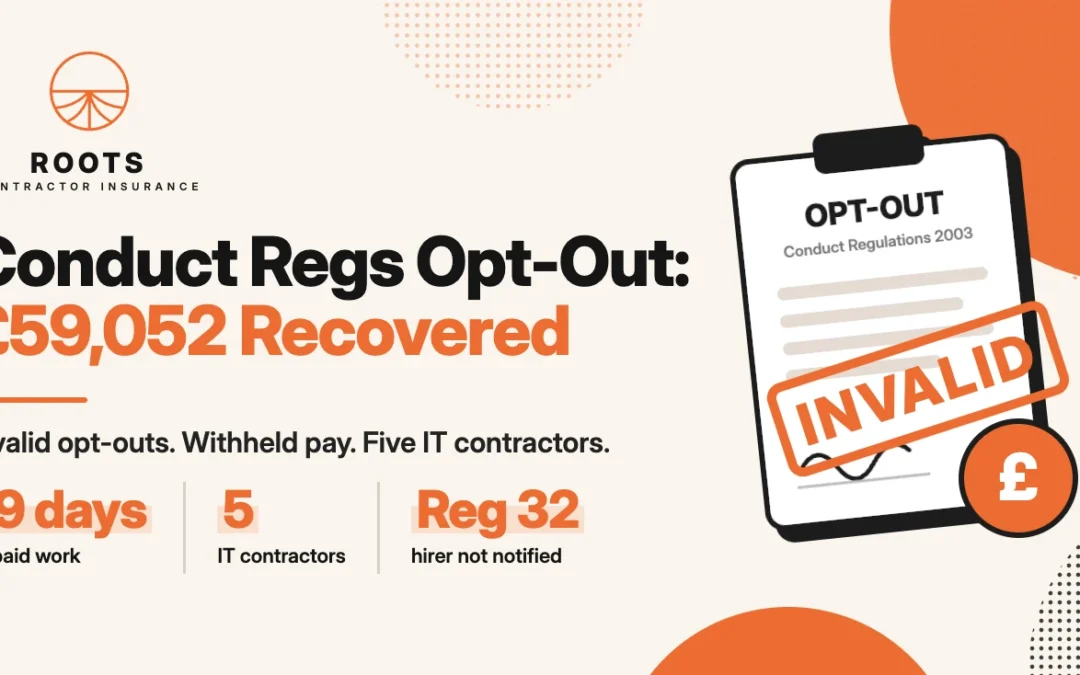
Fair Work Agency Recovers £59,000 for Five IT Contractors: Why a Conduct Regulations Opt-Out Is Only Valid If It Is Done Properly
Five IT contractors have recovered £59,052 in withheld pay after the Fair Work Agency found that the Conduct Regulations opt-out each had signed with their recruitment agency was not valid.
The agency had refused to pay for 19 days of work completed in May 2026, arguing that the contractors had moved on to work through another employment business and had each signed an agreement opting out of the Conduct of Employment Agencies and Employment Businesses Regulations 2003.
That argument failed.
The case, published by the Fair Work Agency and followed up by ContractorUK on 18 November, is a useful reminder for limited company contractors and recruitment agencies alike: a Conduct Regulations opt-out is a legal process, not a box to tick.
What happened?
The five contractors complained to the Fair Work Agency’s Employment Agency Compliance team that they had not been paid for 19 days of work supplied through an agency.
The agency told investigators it had withheld payment because the contractors had left to work through a different employment business, and because each had opted out of the Conduct Regulations.
However, the agency could not provide sufficient evidence that the hirer had been notified of the opt-out agreements, as Regulation 32 requires. Without that evidence, the opt-outs were treated as invalid and the Conduct Regulations continued to apply.
The Fair Work Agency found that withholding the money breached Regulation 12, which generally prevents an employment business from withholding pay for work a contractor has already done. The agency paid in full, with individual amounts ranging from £9,120 to £17,100.
Notably, the matter was resolved without an Employment Tribunal claim.
What are the Conduct Regulations?
The Conduct Regulations set minimum standards for recruitment agencies and employment businesses, protecting both the people they supply and the hiring clients.
Among other things, they restrict when an employment business can withhold pay. An agency cannot generally refuse to pay a contractor because the end client has not paid the agency, because a timesheet has not been signed, or because the contractor has moved on to other work.
Contractors who work through their own limited company can choose to opt out. Many outside IR35 contractors do so because they regard themselves as independent businesses rather than agency workers.
Opting out is a choice, not a requirement. Under Regulation 32(13), an employment business cannot make its work-finding services conditional on a contractor opting out.
What makes a Conduct Regulations opt-out valid?
The default position is that the Conduct Regulations apply. They only stop applying where a valid opt-out is in place.
In general terms, the contractor and their limited company must both agree to opt out and give notice of that agreement to the agency, and this should happen before the contractor is introduced or supplied to the end client. The employment business must then inform the hirer that the opt-out has been given.
An opt-out is not available where the contractor will be working with children under 18 or vulnerable adults.
The Fair Work Agency’s announcement makes the practical point clearly: agencies need a reliable process for recording whether a contractor wishes to opt out, a formal opt-out agreement on file and evidence that the hirer has been told.
If the agency cannot show this, a signed form on its own may not be enough.
Does a Conduct Regulations opt-out affect IR35?
Not on its own.
The Conduct Regulations and IR35 are separate pieces of law. Opting out does not make an engagement outside IR35, and remaining opted in does not automatically make it inside IR35.
HMRC and the tribunals look at the reality of the working relationship, including control, substitution, mutuality of obligation and the wider commercial arrangements. We cover the most common misunderstandings in our guide to IR35 myths and misconceptions.
That said, an opt-out can sit comfortably alongside a genuinely independent, business-to-business arrangement, which is why it is common among outside IR35 contractors. The important thing is that the paperwork matches how the engagement actually works.
An IR35 Status Review can help contractors check whether their contract and working practices support the status they believe applies.
What does this mean for recruitment agencies?
The Fair Work Agency has been operational since 7 April 2026, and it has made clear that it is taking an active interest in how agencies treat the contractors they supply.
Speaking to ContractorUK about this case, a Fair Work Agency spokesperson said it was “not a one-off approach”.
The agency’s wider figures support that. Since April, more than £300,000 has been recovered and paid to workers, and its Employment Tribunal Penalties team has helped secure payment in 80 cases worth over £665,000.
For agencies, the lessons are practical. Review opt-out paperwork, confirm that the hirer is notified and that the notification is recorded, and pay contractors promptly for work they have completed.
Opt-out records sit alongside other supply-chain duties agencies already carry, including the new Right to Work checks and IR35 status determinations.
Relying on an opt-out that cannot be evidenced may leave an agency exposed to repayment, investigation and, where a tribunal is involved, potential penalties.
What should individual contractors do?
Before opting out, contractors should understand which protections they are giving up. Once a valid opt-out is in place, the payment protections in Regulation 12 will generally no longer apply, and payment disputes become a matter of contract.
Contractors should keep copies of their opt-out documents, their contracts, timesheets and any correspondence about payment.
Where a contractor supplied through an employment business believes they have not been paid for work done, they can contact the Fair Work Agency on 0345 161 6000 or record a complaint online.
Contractors should also consider what support they would have if a payment or contract dispute escalated. Contractor Legal Protect can help with the legal costs of pursuing or defending covered commercial disputes, including contract disputes and debt recovery, subject to policy terms. Legal expenses policies generally do not cover disputes that began before cover started, so the time to arrange it is before a problem arises. We explain why in The Importance of Contractor Legal Protection Insurance.
Alongside this, Professional Indemnity Insurance and IR35 Insurance address different risks, from negligence claims to HMRC enquiries.
Is more change coming?
Possibly.
The government consulted earlier this year on modernising the framework for employment agencies and employment businesses, including the Conduct Regulations. That consultation closed in May 2026 and the government’s response is still awaited. It is expected to focus on bringing umbrella companies into scope, following the umbrella company reforms that took effect in April.
Separately, the government’s wider review of employment status, which we covered in Employment Status Reform 2026, leaves tax status and IR35 outside its scope.
Until then, the existing rules apply, and the Fair Work Agency is enforcing them.
The key takeaway
A Conduct Regulations opt-out is only as strong as the process behind it.
In this case, five IT contractors were paid in full because their agency could not show that the hirer had been told about the opt-outs.
For agencies, that means tightening processes and records. For contractors, it means understanding exactly what an opt-out does, keeping good records and making sure the right protection is in place before a dispute arises.
Related articles
Frequently Asked Questions
Was the £59,000 a fine imposed on the agency?
No. The £59,052 was the pay the five contractors were owed for work already completed. The agency was required to pay it in full.
Can a limited company contractor opt out of the Conduct Regulations?
Yes, in most cases. The opt-out must be given properly and in time, and it is not available where the contractor works with children under 18 or vulnerable adults.
Does a Conduct Regulations opt-out mean I am outside IR35?
No. IR35 status depends on the contract and the actual working arrangements. The Conduct Regulations are a separate set of rules.
Can an agency insist that I opt out?
No. An employment business cannot make its work-finding services conditional on a contractor opting out.