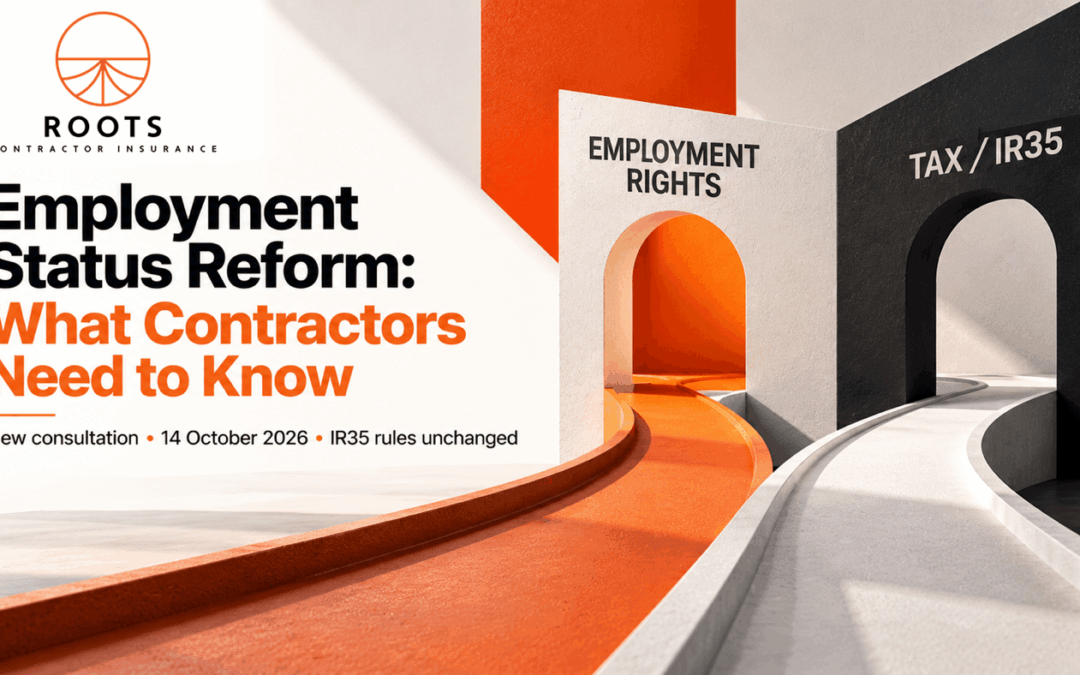
Employment Status Reform 2026: What the New Consultation Means for UK Contractors
The government has opened a consultation that could change how employment rights are determined for people working outside conventional employment. Published on the 14th October 2026, the proposals examine substitution clauses, client control and protections for genuinely self-employed people.
For UK contractors, there is one particularly important distinction: the consultation concerns employment rights, not IR35 or tax status. No changes to the off-payroll working rules have been announced through this exercise.
Nevertheless, the proposals could influence how clients, recruitment agencies and contractors structure working relationships in future.
What is the government proposing?
The government’s new Make Work Pay consultation focuses on people who may be described as self-employed despite working under substantial direction from a business.
The government is seeking views on giving less weight to personal service when deciding whether someone qualifies as a worker for employment rights purposes.
It is also considering a presumption of worker status, potentially requiring an engager to demonstrate that an individual is genuinely self-employed in relevant disputes.
Other proposals include clearer written terms for self-employed individuals and possible extensions to certain blacklisting and health-and-safety protections.
These are proposals, not new legal requirements. The existing framework remains in place while the consultation proceeds.
Why do substitution and control matter?
Contractors will recognise two of the concepts attracting attention: substitution and control.
A substitution clause may allow a contractor to arrange for another suitably qualified person to perform the work. Control concerns the extent to which the client directs how the services are delivered.
Under the proposed employment rights approach, a substitution right might carry less weight where the individual is nevertheless subject to significant control.
The intention is to prevent contractual wording from obscuring the practical reality of the relationship.
This does not mean substitution is being removed from the IR35 tests.
For tax purposes, a genuine substitution right and the reality of client control remain relevant factors within the overall status assessment.
A clause that exists only on paper is unlikely to provide the same support as a right that genuinely operates in practice.
Employment rights and IR35 are different questions
UK employment law broadly distinguishes between employees, workers and genuinely self-employed individuals.
Tax status uses a separate framework, and the off-payroll working rules address whether a person providing services through an intermediary would be treated as employed for tax purposes.
That difference can produce an uncomfortable outcome: a limited company contractor may be taxed as inside IR35 without automatically receiving employment rights from the end client.
Conversely, being genuinely self-employed for tax purposes does not necessarily resolve every employment rights question.
The government has explicitly kept tax outside this consultation.
It therefore does not resolve the long running debate about the relationship between inside IR35 taxation and employment protections.
Contractors should avoid interpreting any future employment rights reform as an automatic change to their IR35 position.
Could genuine limited company contractors be affected?
Potentially, but the effect will depend on the final proposals, any legislation and the actual engagement.
The consultation is particularly concerned with arrangements where individuals are labelled self-employed but operate under considerable direction.
It is not an announcement that all independent consultants, freelancers or personal service company directors will become workers.
A genuinely independent contractor delivering agreed outcomes, managing how work is performed and operating a business on their own account is in a different position from someone whose daily working arrangements resemble those of a directly managed worker.
For agencies and end clients, the practical lesson is to avoid relying on labels alone.
The substance of the arrangement matters, even when the contract contains familiar self-employment wording.
What should contractors do now?
There is no need to rewrite contracts solely because a consultation has opened.
However, contractors can use this opportunity to check whether their documentation reflects reality.
Review the scope of services, project deliverables, decision-making autonomy, substitution arrangements and how changes to the assignment are agreed.
Retain relevant evidence of how the engagement operates, rather than relying entirely on a status opinion produced at the outset.
Where a medium or large private-sector client or a public authority is responsible for an IR35 determination, contractors should obtain the Status Determination Statement (SDS) and understand the reasons given.
HMRC guidance confirms that a contractor can challenge an SDS and that the client generally has 45 days to respond to a properly raised disagreement.
An IR35 Status Review can help identify clauses that may need clarification before an assignment starts or is renewed.
How does contractor insurance fit in?
Employment rights reform is not itself an insured event, and insurance cannot replace sound contractual arrangements.
However, independent businesses still need to consider the risks arising from their work.
Professional Indemnity Insurance responds to covered allegations of professional error or negligence.
Public Liability Insurance concerns third-party injury or property damage, while Employers’ Liability Insurance may be required depending on the company’s circumstances.
Separately, IR35 Insurance can provide specified protection for covered HMRC IR35 enquiries and, where selected, certain liabilities, subject to policy wording and limits.
Roots Contractor Insurance also offers IR35 Contract Reviews and IR35 Status Reviews to help contractors assess the terms of their engagements.
Have your say before 8 January 2027
The consultation closes on the 8th January 2027.
Contractors, recruitment agencies and end clients can review the proposals and submit their views directly through the government’s consultation process.
Read and respond to the official government consultation
For now, the central message is straightforward: employment rights reform is being considered, but IR35 has not been changed by this consultation.
Contractors should continue to assess their engagements under the existing rules, ensure contracts match working practices and follow the debate as it develops.
Frequently Asked Questions
Has IR35 changed because of the October 2026 consultation?
No. The consultation covers employment rights, not the separate tax status framework or off-payroll working rules.
Will substitution clauses stop helping an outside IR35 assessment?
No such IR35 change has been announced. The consultation explores giving substitution less weight when deciding worker status for employment-rights purposes.
Do inside IR35 contractors automatically receive holiday pay and other employment rights?
No. Being taxed as inside IR35 does not, by itself, establish employment or worker rights against the client.
When does the consultation close?
The government’s deadline is the 8th January 2027.