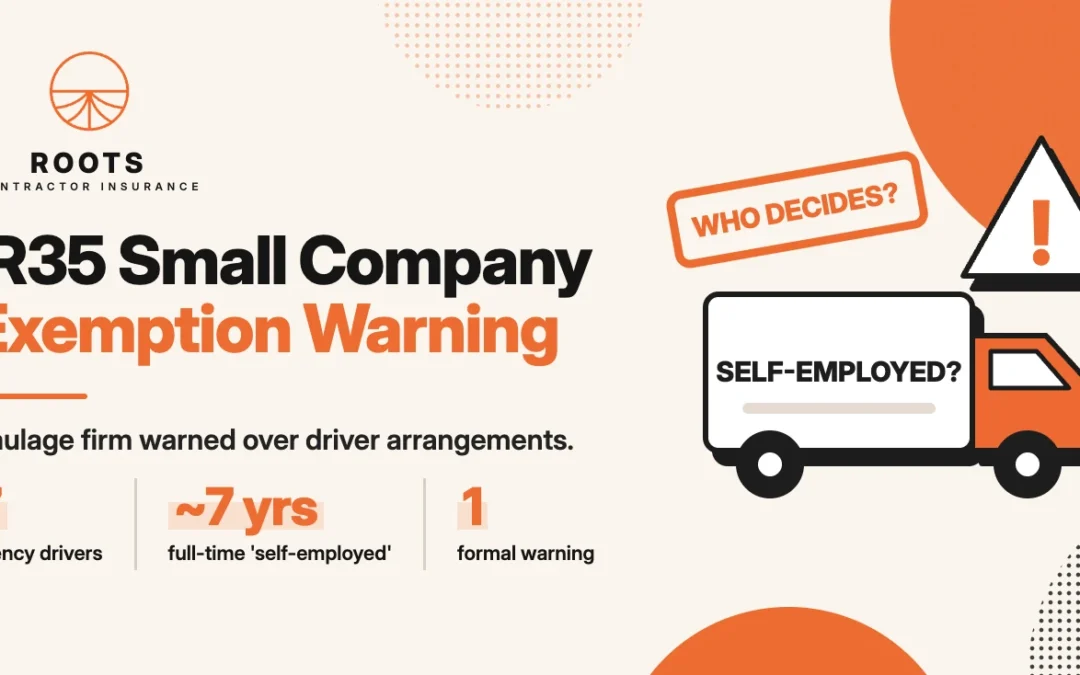
Haulage Firm Warned After Relying on the IR35 Small Company Exemption: What Contractors and Agencies Should Take From It
A Northamptonshire haulage operator has received a formal warning from the Traffic Commissioner after relying on the IR35 small company exemption to explain how its drivers were engaged.
The case is not an HMRC IR35 investigation. It is a transport licensing decision.
But it offers a useful reminder of what the small company rules do and, perhaps more importantly, what they do not do.
The decision, published on GOV.UK on the 23rd of October 2026, concerns SCS Haulage Ltd and followed a public inquiry before Traffic Commissioner Richard Turfitt on the 29th of September 2026.
What happened at SCS Haulage?
On the 28th of January 2026, a DVSA stop found one of the operator’s vehicles being used without an operator licence disc.
The driver said he was self-employed. He invoiced through his own limited company, of which he was a director, despite having worked full time for the operator for around seven years.
A later DVSA traffic examiner visit in April 2026 found that the operator was engaging drivers through several agencies.
One of those agencies, DS Drivers Ltd, supplied seven drivers. The decision records that the operator’s directors were also directors of that agency.
The operator also employed nine full-time drivers on PAYE.
Why did the IR35 small company exemption not settle the question?
In its explanation to the Commissioner, the operator said that it met the IR35 criteria for a small company, and that responsibility lay with the agencies supplying the drivers.
The Traffic Commissioner was not persuaded.
The decision states: “The reliance on IR35 called into question the level of knowledge and ability to oversee compliance.”
The Commissioner found that the drivers were inducted and managed in much the same way as employees, and were under the control and direction of the operator. In the decision’s words, what was described “did not amount to a self-employed driver.”
The Commissioner accepted that the reliance on IR35 was a genuine misunderstanding, but noted that the arrangements were sophisticated.
The operator received a formal warning, with conditions attached to its licence, and gave an undertaking that permanent drivers will be employed on PAYE.
What does the IR35 small company exemption actually do?
This is where confusion often arises.
Under the off-payroll working rules, the client is usually responsible for deciding a worker’s employment status. But where a client outside the public sector is small, that duty does not sit with the client.
Instead, as GOV.UK guidance explains, the worker’s intermediary, usually their limited company, is responsible for deciding the worker’s status and whether the rules apply.
In other words, the exemption changes who makes the decision.
It does not mean IR35 stops applying, and it does not turn an employment-like engagement into self-employment.
According to HMRC’s Employment Status Manual, a company is medium or large if it meets at least two of three conditions for two consecutive financial years: turnover of more than £15 million, a balance sheet total of more than £7.5 million, or more than 50 employees. The higher turnover and balance sheet figures apply to financial years beginning on or after the 6th of April 2025.
We looked at how the test works in more detail in HMRC’s IR35 Small Business Exemption Explained, and at how the thresholds have moved in IR35 Threshold Changes: What Businesses and Contractors Need to Know.
Who decides status under the IR35 small company exemption?
For a contractor working through a limited company for a small private sector client, the answer is usually the contractor’s own company.
That can feel like freedom. It is also a responsibility.
If HMRC later opened an enquiry, it would generally be the contractor’s company that needed to show how it reached its view, and that could face any tax, interest and penalties if HMRC disagreed.
Our guide on who is responsible for IR35 status explains how the duty can move around the supply chain depending on the size and sector of the client.
Why do agency arrangements matter?
The operator argued that responsibility lay with the agencies.
GOV.UK makes clear that the size rules only apply to clients, and that all agencies, regardless of size, will have some responsibilities.
That is one reason we have highlighted the importance of clear processes in What Start-Up Recruitment Agencies Need to Know About IR35 Compliance.
The case also shows that regulators other than HMRC may take an interest in how workers are engaged, particularly in sectors with their own licensing regimes.
It comes at a time when employment status is firmly on the agenda, as we covered in Employment Status Reform 2026, although that consultation concerns employment rights rather than the IR35 tax rules.
What should contractors and agencies take from this?
Perhaps the most important point is that labels rarely decide status. The working reality usually does.
A long-term, full-time engagement, with the same induction, procedures and supervision as employees, is likely to attract scrutiny whatever the paperwork says.
For contractors working for small clients, it may be sensible to assess and document status at the start of each engagement, and to review it if the working arrangements change.
An independent IR35 Status Review can help identify potential issues and create a record of the reasoning behind a determination.
Contractor IR35 Protect may provide professional representation in covered HMRC enquiries, including IR35 status investigations, with the option to add cover for tax liabilities, interest and penalties, subject to policy terms.
For recruitment agencies and end clients, Fee Payer IR35 Protect is designed to cover representation costs and IR35 tax liabilities, interest and penalties arising from covered HMRC IR35 enquiries, again subject to policy terms.
Insurance does not decide IR35 status, and it is not a substitute for getting the working arrangements right. Where the position is unclear, professional advice is recommended.
The key takeaway
The SCS Haulage decision is a licensing case, not an IR35 ruling, but its message is relevant to anyone in the contractor supply chain.
The IR35 small company exemption decides who is responsible for the status decision. It does not make that decision for you.
Contractors working for small clients, and the agencies that supply them, may wish to make sure that status has been properly considered and documented, rather than assumed.
Related articles
Frequently Asked Questions
Does the IR35 small company exemption mean IR35 does not apply?
No. Where a private sector client is small, the contractor’s intermediary, usually their limited company, is responsible for deciding status and whether the rules apply.
What are the current small company thresholds?
HMRC treats a company as medium or large if it meets two or more of: turnover over £15 million, a balance sheet total over £7.5 million and more than 50 employees, for two consecutive financial years. The higher figures apply to financial years beginning on or after the 6th of April 2025.
Was the SCS Haulage case an HMRC IR35 investigation?
No. It was a Traffic Commissioner licensing decision following DVSA investigations. The operator received a formal warning and conditions on its licence.
Do agencies have IR35 responsibilities if the client is small?
GOV.UK says the size rules only apply to clients and that all agencies, regardless of size, will have some responsibilities. Professional advice may help where the position is unclear.